Navigating the Medical Matrix: Why You Need a Personal Physician More Than Ever
By Dr. Jithesh K, MD, MRCP (UK)
Healthcare has changed dramatically over the last few decades. The days of the familiar family doctor who knew your entire medical history have largely been replaced by sprawling, multi-specialty corporate hospitals. While these modern institutions offer incredible, life-saving technology, they can also feel overwhelming, impersonal, and highly transactional.
In this era of corporatized medicine, having a long-term personal physician by your side isn’t just a comforting luxury—it is an absolute necessity for your health, peace of mind, and financial well-being. Here is why.
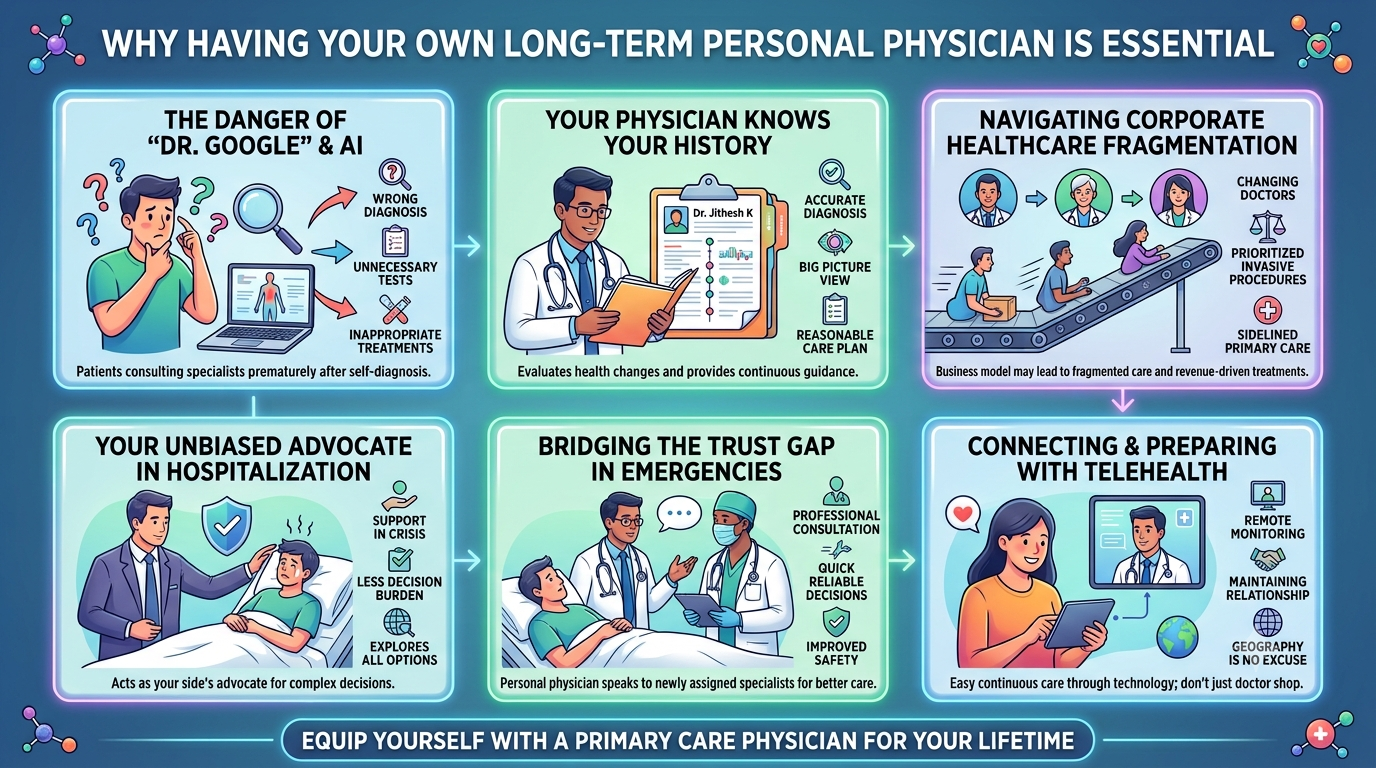
The Trap of "Dr. Google" and AI Self-Diagnosis
We all do it: a strange pain starts, and immediately, we pull out our smartphones to search our symptoms. Today, armed with Google and AI chatbots, patients frequently try to diagnose themselves. This often leads to panic and a dangerous trend of "self-referral."
Instead of seeing a general physician, a patient with chest pain might bypass primary care and directly book an appointment with a cardiologist. But what if that pain is just severe acid reflux?
The Result: You end up in the wrong department, undergoing inappropriate and expensive investigations, receiving needless treatments, and enduring a lot of unnecessary anxiety.
The Value of a Doctor Who Actually Knows You
A long-term personal physician looks at the big picture. Because they know your complete medical history, lifestyle, and past health hurdles, they can easily separate a minor issue from a serious red flag. They make a reasonable, grounded diagnosis first. If your condition genuinely requires an organ specialist or a surgeon, your primary doctor will know exactly who to refer you to and when. This saves you time, money, and stress.
The Exhaustion of the "Second Opinion" Chase
When a corporate hospital suddenly advises a major surgery or an invasive procedure, it is entirely normal to feel doubtful. This often triggers a frantic scramble for a second, third, or even fourth opinion from different hospitals, leaving you exhausted and confused by conflicting advice.
If you already have a long-term primary physician, this chaotic scramble is eliminated. You can simply take the specialist's recommendation back to your personal doctor. Because they are unbiased and understand both the medical data and your personal context, they can help you validate the treatment plan and reach an easy, confident decision without the runaround.
The Reality of the Corporate Healthcare Machine
Corporate hospitals are businesses. While they house excellent specialists, their structure often leads to the fragmentation of your care. You might see a different doctor every time you visit, meaning nobody is connecting the dots of your overall health.
Furthermore, the business model of corporate healthcare often prioritizes revenue. Patients who need invasive, high-cost procedures naturally generate more revenue for the institution. Unfortunately, this can sometimes lead to the sidelining of patients who simply need routine, non-invasive primary care.
Your Unbiased Advocate in the Hospital Maze
Imagine a complex medical scenario where you or a loved one must be hospitalized for a serious illness requiring tertiary or quaternary care. You are suddenly thrust into a chaotic "medical matrix," burdened by the physical pain of the disease, deep emotional stress, and mounting financial bills.
In these moments, you are often asked to make rapid, complex medical decisions.
This is where your personal physician becomes your greatest asset.
Acting as an unbiased advocate who is firmly on your side, they can explain the jargon, weigh the options without any financial conflict of interest, and guide you through the decision-making process. They take the heavy burden of choice off your shoulders when you are most vulnerable.
Geography is No Longer an Excuse
You might wonder how a personal physician can help if you are traveling or referred to a hospital in a completely different city. Today, maintaining this vital relationship is easier than ever.
Thanks to telehealth, secure internet portals, and AI summaries, your primary physician can stay entirely up-to-date on your condition. Even if you are hospitalized in a different geographical area, your personal doctor can review your charts remotely, speak with your treating specialists, and guide your care from afar.
Bridging the Trust Deficit During Emergencies
Today, there is a growing, undeniable distrust between patients and doctors, largely fueled by the corporatization of hospitals and fears of overcharging. This trust deficit becomes dangerous during medical emergencies.
If you are wheeled into an emergency room and a newly assigned sub-specialist is about to operate on you, having an unbiased personal physician changes everything. Your primary doctor can speak directly to the surgeon, discussing your pre-existing conditions, medications, and overall health. This professional-to-professional collaboration allows for quick, reliable, and safe decisions, bridging the trust gap and ensuring you get exactly the care you need.
Stop Lamenting, Start Equipping
There is no point in simply lamenting the rising corporatization and business-minded nature of modern medicine—it is the reality of the world we live in. The best and most practical way to protect yourself is to face this reality head-on and equip yourself with a primary care physician for your lifetime.
"Doctor shopping" might be perfectly fine when you are looking for a highly specific surgeon to perform a complex procedure. However, to safeguard your foundational health and your finances, you need a single, reliable, approachable, and up-to-date primary physician. Don't wait for a crisis; build that relationship today.
About the Author:Dr. Jithesh K, MD, MRCP (UK), is a Senior Consultant Physician and Medical Administrator based in Kozhikode, Kerala. He is dedicated to patient advocacy, ethical clinical practices, and providing accessible medical education.