Diabetes Management: Moving from Daily Tablets and Insulin Injections to Weekly Injections and Inhaled Insulins
For generations, the paradigm of diabetes management has been rigid. If you were diagnosed with diabetes, your future was predictable: a steadily compounding regimen of daily oral tablets, often culminating in multiple painful daily insulin pricks. The psychological, emotional, and practical toll of this "daily grind" has been one of the biggest roadblocks to achieving optimal glycemic control.
But medicine is undergoing a monumental shift. We are officially stepping into the era of ultra-long-acting weekly therapies and needle-free inhaled delivery systems.
For the common man, this means an unprecedented leap in lifestyle freedom. For the physician, it requires a complete recalibration of how we design treatment protocols. Let’s break down the four cutting-edge therapies redrawing the battle lines against diabetes—with a clear look at their mechanisms, pros, cons, costs, and unique clinical realities in India.
The New Lineup: Meet the Game-Changers
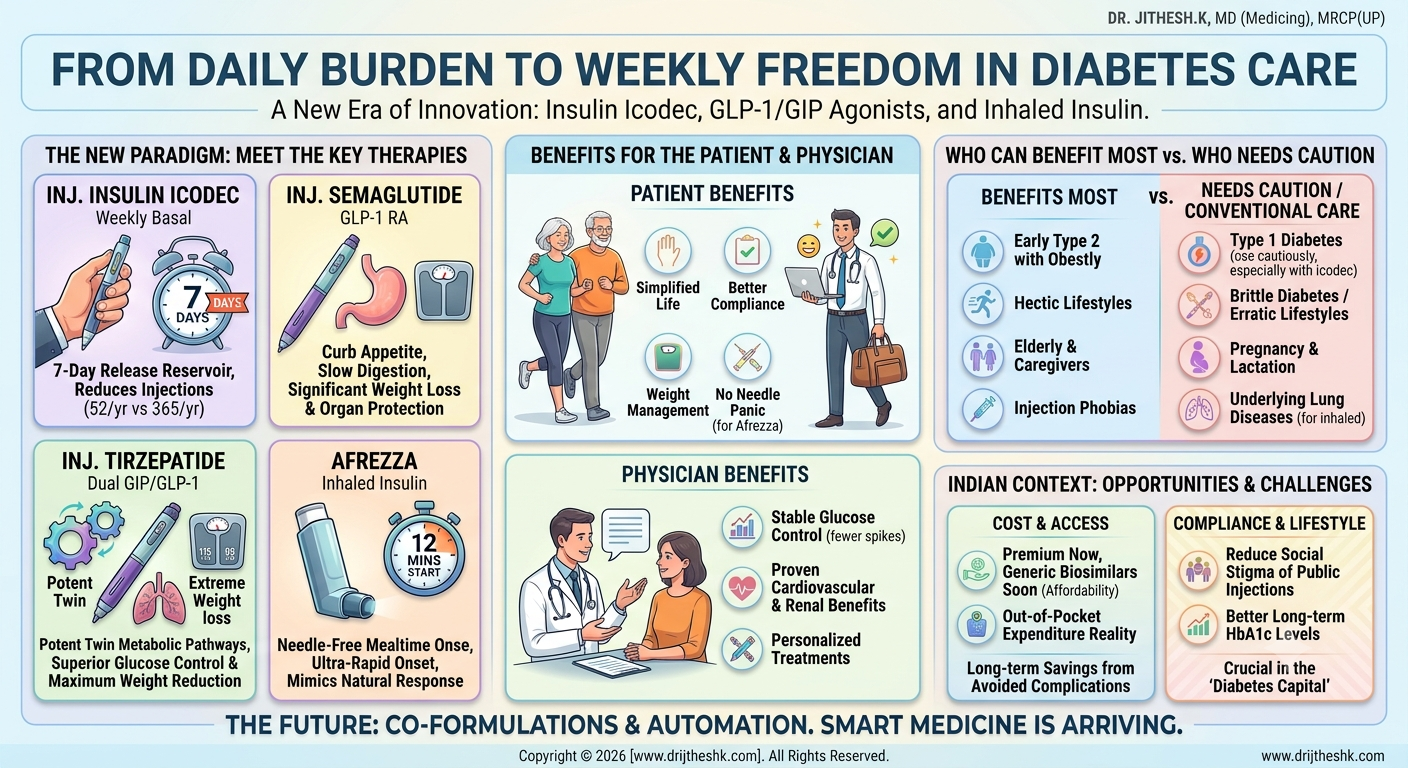
Game-changer drugs in diabetes management
1. Inj. Insulin Icodec: The 7-Day Basal Insulin
The Science: Unlike standard basal insulins (like Glargine) that work for 24 hours, Icodec is structurally engineered to bind strongly yet reversibly to albumin in the bloodstream. This creates a slow-release reservoir that continuously drops active insulin into the body over 7 days.
The Impact: It slashes the basal injection burden from 365 shots to just 52 shots a year. Clinical trial data (the ONWARDS program) demonstrates HbA1c reduction non-inferior—and occasionally superior—to daily basal choices.
2. Inj. Semaglutide: The Metabolic Re-engineer
The Science: Available as a once-weekly subcutaneous injection, Semaglutide mimics the GLP-1 (Glucagon-Like Peptide-1) gut hormone. It prompts the pancreas to secrete insulin only when blood sugar rises, slows down gastric emptying to keep you full longer, and signals the brain to curb appetite.
The Impact: Beyond stellar glucose control, it provides massive cardiorenal protection and profound weight loss benefits.
3. Inj. Tirzepatide: The "Twincretin" Powerhouse
The Science: Taking therapy a step further, Tirzepatide is a single molecule that targets two metabolic pathways: GIP (Glucose-dependent Insulinotropic Polypeptide) and GLP-1.
The Impact: It acts as a dual weight-loss and glycemic engine. In the landmark SURMOUNT and SURPASS trials, it shattered expectations by showing up to 20–22% body weight reduction, making it arguably the most potent metabolic agent in modern diabetology.
4. Afrezza: The Needle-Free Mealtime Inhaled Insulin
The Science: Afrezza replaces the dreaded rapid-acting "prandial" (mealtime) skin punctures. Delivered via a dry-powder inhaler using Technosphere microparticle technology, the human insulin is inhaled into the lungs, where it instantly crosses into the capillaries.
The Impact: It boasts an ultra-rapid onset of action (~12 minutes), hitting the bloodstream faster than traditional rapid-acting subcutaneous analogs and clearing out quickly, closely mirroring a healthy pancreas's natural response to a meal.
Pros & Cons: A Balanced Medical Look
The Advantages (Pros)
Unrivaled Compliance: Moving from 7 or 14 injections a week down to 1 or 2 dramatically removes user fatigue and injection anxiety.
Weight Management: Traditional insulins cause weight gain. Semaglutide and Tirzepatide reverse this completely, addressing the root driver of Type 2 Diabetes: visceral obesity and severe insulin resistance.
Organ Protection: Weekly GLP-1 and dual-receptor therapies actively lower the risk of stroke, heart attacks, and diabetic kidney progression.
Blunting Post-Meal Spikes: Afrezza provides a rapid-acting, completely needle-free option to control post-lunch or post-dinner glucose surges without the lag time of standard injections.
The Drawbacks (Cons)
Gastrointestinal Distress: Semaglutide and Tirzepatide regularly trigger initial nausea, vomiting, or diarrhea, requiring a slow, disciplined dose titration over several weeks.
Hypoglycemia Longevity: If a patient on Insulin Icodec experiences severe low blood sugar, the molecule cannot be withdrawn from the system. Hypoglycemia management requires a longer window of close surveillance.
Pulmonary Constraints: Afrezza cannot be prescribed to anyone with underlying lung pathology (Asthma, COPD) due to a direct risk of acute bronchospasm. Regular lung function assessments (Spirometry) are mandatory.
Who Benefits the Most?
The Early-Stage Type 2 Diabetic with Obesity: Patients with high body mass indexes (BMIs) and notable insulin resistance get a dual advantage with Tirzepatide or Semaglutide—excellent HbA1c control alongside substantial weight loss.
Hectic/Unpredictable Lifestyles: Jet-setting corporate professionals, shift workers, and frequent travelers who routinely miss daily dosing slots find a stable anchor in weekly options.
The Elderly & Assisted-Care Patients: Seniors who struggle with manual dexterity to pull daily precise doses can rely on a caregiver administering a weekly pen.
Injection-Phobic Individuals: Patients delaying necessary mealtime insulin therapy out of a fear of needles can smoothly transition to inhaled Afrezza.
Who Must Stick with Conventional Care?
Despite the clinical brilliance of these therapies, a massive demographic must remain on conventional oral hypoglycemic agents (OHAs) and multiple daily injections (MDI):
1. Type 1 Diabetics (With Strict Exceptions)
Type 1 Diabetics produce zero intrinsic insulin. They rely completely on rapid, flexible adjustments matched to exactly what they eat. While weekly basal options like Icodec are tested, clinical data shows a significantly higher risk of severe hypoglycemia. For prandial needs, Type 1 patients can use Afrezza, but it must still be paired with a daily injectable background basal insulin.
2. Brittle Diabetics & Fluctuating Lifestyles
Patients prone to erratic glycemic swings, recurrent ketoacidosis, or highly volatile daily schedules cannot use an irreversible weekly insulin like Icodec. They need short-acting, nimble daily options that can be adjusted meal-by-meal.
3. Pregnancy and Lactation
New weekly agents and inhaled options lack comprehensive safety profiles for pregnant or breastfeeding women. Conventional, thoroughly studied daily human insulins remain the undisputed gold standard here.
The Indian Scenario: Cost & Reality Check
India is facing a massive public health crisis with over 101 million individuals diagnosed with diabetes (per the ICMR-INDIAB study). Because healthcare expenditure in India is heavily driven by out-of-pocket spending, economics dictate which therapies survive the transition from clinic to kitchen.
The Premium Barrier vs. The Generic Horizon
Tirzepatide & Semaglutide: Original brand innovations command premium pricing, often scaling from ₹14,000 to ₹27,500+ per month depending on titrated dosages. This restricts initial access to affluent tiers. However, a major market shift is on the horizon: as primary molecule patents expire, domestic Indian pharmaceutical giants are rolling out highly affordable generic biosimilars.
Afrezza's Indian Footprint: Formally distributed in India via a strategic partnership with Cipla, Afrezza offers a premium, localized, needle-free alternative. A monthly pack can run several thousand rupees depending on total cartridge requirements, appealing to urban, middle-to-high-income patient bases wanting lifestyle convenience.
The Pharmacoeconomic Equation
Physicians and patients shouldn't judge these drugs strictly on the monthly price tag of the pharmacy receipt. When calculating the overall cost of care, one must subtract the reduced need for test strips, syringes, disposable needles, and anti-obesity medications. Furthermore, by drastically dropping HbA1c, these medications lower the astronomical, long-term costs associated with managing diabetic complications like dialysis, coronary stenting, and retinopathy treatments.
Future Directions: Where Are We Heading?
The ultimate trajectory of diabetology is shifting toward Smart Medicine and Automation. We are moving toward co-formulated weekly injections (e.g., combining Icodec with a weekly GLP-1 receptor agonist into a single pen) so a patient can hit glucose production, satiety, and insulin deficiency with one weekly click.
Simultaneously, when paired with continuous glucose monitors (CGMs), ultra-rapid therapies like Afrezza are laying the groundwork for highly automated, non-invasive approaches to managing sudden spikes. While conventional daily tablets and daily insulins will remain the foundational, affordable shield protecting rural and lower-income patient populations, these weekly and needle-free innovations are setting a new standard for proactive, lifestyle-centered clinical care.
Written By:
Dr. Jithesh.K, MD(Medicine), MRCP(UK)
Senior Consultant Physician
Disclaimer: This blog post is for informational and educational purposes only and does not substitute professional medical advice, diagnosis, or treatment. Always consult your doctor before making any changes to your medication regimen.
Copyright © 2026 www.drjitheshk.com. All Rights Reserved.